Warehouse automation solution design: what the process should include
Supply chains inherit business decisions including new channels, seasonal promotions, and SKU expansions, often with little or no warning. The warehouse has to execute on them regardless. That creates a specific set of demands on automation that a generic ‘warehouse’ conversation doesn’t always capture:
- Demand volatility: Peak periods routinely run 3-5x average daily volume. Systems that degrade under load aren't acceptable.
- Order profile variability: Not only do peak periods result in drastically different demand requirements, but the order profile (units/order, units/line, bag and box percentages) can change at a macro level (between years) and a micro level (between days of peak).
- SKU proliferation: Catalogues span tens or hundreds of thousands of active SKUs, with velocity profiles that shift constantly. A design sized to today’s catalogue alone won’t hold; it needs to be sensitivity-tested against how quickly SKU mix and velocity can shift.
- Channel complexity: The same facility may fulfill e-commerce units, mixed-case orders for store replenishment, and full-pallet wholesale simultaneously, each with different throughput and packaging requirements.
- Integration depth: Automation rarely involves a single technology. Goods-to-person picking, sortation, packaging, pallet handling, and downstream processing need to work together as a unified system.
Swisslog’s eBook, Designing for what’s next: Modular, software-orchestrated automation for retail observes that flexibility has become just as important as throughput or productivity when evaluating technology investments. The central question today isn’t whether to automate, it’s how to automate in ways that address current needs without sacrificing future flexibility. That question can only be answered well by a design process that takes it seriously from the start.
What a warehouse automation solution design process should include
Start with the right data, and enough of it
Automation designs are only as accurate as the data that grounds them. For operations with strong seasonality and promotional volatility, a snapshot of current operations is never sufficient. 12–24 months of historical operational data is the right starting point: actual order profiles across a full seasonal cycle, SKU velocity distribution, inventory levels, and replenishment patterns at enough resolution that the design can be stress-tested against real conditions, not industry averages. Because business conditions continue to evolve, event recently collected operational data represents a snapshot in time. That’s why strong design processes test multiple future scenarios rather than relying on a single set of assumptions.
The design should also factor in growth. A system sized only for today’s volume will constrain the business it was meant to enable. Integrators won’t be able to determine your growth – this is something they will look for you to come with a perspective on.
Using simulation in warehouse automation solution design
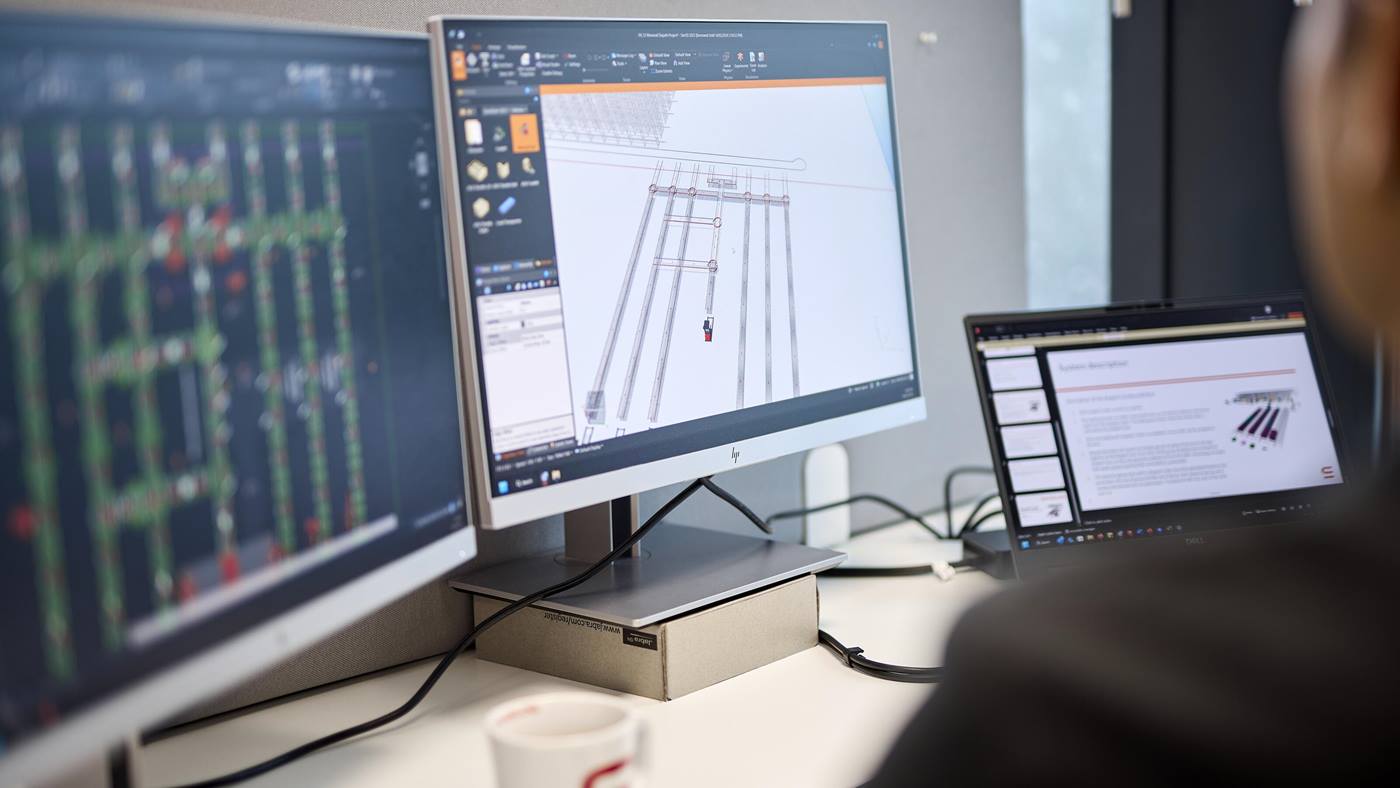
One of the most significant advances in automation design is the ability to model complex systems in simulation before hardware is ordered. For applications where multiple subsystems interact, peak loads are dramatic, and order profiles are complex, simulation is not optional.
For AutoStore implementations, that means running many simulations simultaneously to fine-tune every aspect: changing robot, port, and bin quantity on the fly across as many scenarios as the project requires. AutoStore’s simulator tools are updated from live, operational systems, so the results reflect real-world performance rather than theoretical models.
Simulation finds the problems that proposals don’t show: merge-point conflicts, sequencing failures, robot fleet constraints that only appear under realistic peak concurrency. It’s the difference between a design that’s been stress-tested and one that’s been assumed. When evaluating vendors, ask whether simulation was used and what peak scenarios were modeled. A vendor who can’t answer specifically may not have done the work.
Designing warehouse automation for future expansion
Sizing the system for growth only gets you halfway there. The other half is whether the system can actually absorb that growth without teardown. Modular technologies make expansion possible. But the ability to expand smoothly depends on decisions made in the original design. AutoStore grids can be extended and robots or bins added at any time, but only if expansion paths were built in. Port frames, for example, are a specific design feature that allows a new pick or put-away station to be commissioned over a single weekend rather than a multi-week shutdown. That foresight is either in the design, or it isn’t.
Software plays an equally important role. Platforms like Swisslog’s SynQ software orchestrate automation across the facility under a single software spine. When new subsystems are added as the operation grows, SynQ provides the integration layer that prevents expansion from fragmenting the operation.
What happens when a warehouse automation design process is shortchanged
The place where cost-cutting most often shows up in automation projects, often in ways that aren’t immediately visible, is the design process itself. Less data analysis. Fewer simulation runs. A proposal that appears comprehensive but relies on a higher degree of estimation than analysis. The consequences surface months or years after go-live, when they are far more expensive to correct.
When proposals look similar on the surface (comparable robot counts, similar port quantities, close price points), the difference is almost always in the analytical depth underneath. A design built on your actual operational data, validated through simulation, and stress-tested at peak load is a fundamentally different product from one that was estimated. They may look the same in the proposal. They won’t after go-live.
5 questions to ask before approving a warehouse automation proposal
These questions are what our design team asks internally when building a proposal. Put them to every vendor you evaluate. The answers will tell you more about the quality of the design than the proposal document itself.
| Question to ask | What a strong answer looks like | Warning sign |
|---|---|---|
| What assumptions drive your throughput model? | Clear documentation of your actual order profiles, peak scenarios, and SKU velocity—grounded in your data, not benchmarks. | Vague references to industry averages, or an inability to walk through the model. |
| What are the worst-case scenarios, and how does the system handle them? | Explicit simulation runs at peak-of-peak load with documented system behavior at those conditions. | No simulation data, or assurances without supporting evidence. |
| Where is the system constrained? | Honest identification of bottlenecks—port throughput, robot fleet, conveyor merge points—with mitigation designed in. | Reluctance to identify any constraints, or constraints that only surface post-installation. |
| How can I build this system to allow for future growth? | A defined expansion roadmap: grid extension paths, additional robots or bins, port frames pre-installed for fast future commissioning. | A fixed configuration with no clear expansion path beyond "we can add more later." |
| What equipment has the longest lead time? | Component-level lead times with specific schedule implications and a realistic buffer built in. | Generic timelines without component-level detail, or surprise lead-time disclosures mid-project. |
All of that said – Integrator bid teams are exactly that – teams. So, if you don’t get a “green flag” answer immediately, give your integrator contact a chance to engage their team and get you a satisfactory answer.
Key deliverables of a warehouse automation solution design phase
Ask any vendor what the design phase will actually produce and hold the answer against this benchmark:
- System drawings and 3D models covering the full facility layout, equipment placement, and material flow paths.
- A throughput model grounded in your historical data, with documented assumptions and scenario ranges at peak conditions.
- Simulation results demonstrating system performance at average and peak load, with constraints identified.
- A description of operations that articulates exactly how the system will function, from inbound receiving through outbound shipping.
- A growth roadmap showing how the Day-1 system expands over a defined horizon as volume, SKU count, and channel mix evolve.
This package serves two purposes: it’s the foundation of a business case that can be taken to internal leadership with confidence, and it ensures that engineering, contractors, vendors, and the customer are all working from the same understanding of what the system is and what it needs to do.
Your role in a successful warehouse automation design process
Successful automation projects are collaborative. Even the most experienced integrator only knows what your data, operational expertise, and business goals reveal. The more transparent the partnership, the more effectively the solution can be designed, validated, and optimized. Investing time early in the process helps avoid revisions, unexpected costs, and operational challenges after go-live.
Ready to start your warehouse automation solution design?
The success of a warehouse automation project begins long before equipment is installed. A strong solution design, grounded in quality data, validated through simulation, and built with future growth in mind, reduces risk and creates a foundation for long-term success. Technology matters, but it is the design process behind it that ultimately determines whether an automation investment delivers lasting value.
Swisslog’s solution design team brings data-grounded, simulation-validated expertise to warehouse automation projects of every scale. Connect with a specialist or explore our full warehouse automation solutions to learn more.