The rise of the rainbow pallet: What SKU proliferation means for F&B warehouses

Wofford Wise 2. november 2026
Lesetid: 9 minutter
SKU proliferation is reshaping food and beverage distribution. As product ranges grow, driven by channel-specific formats, private label contracts, and industry mergers, distribution centres are under increasing pressure to fulfil more complex orders with systems that were never designed for them. This article explains what is driving SKU growth in F&B, how it is changing warehouse operations, and what automation solutions are helping manufacturers keep pace, from pallet-level ASRS to mixed-case palletizing.

Quick facts

  • Multi-SKU pallets are the fastest-growing fulfilment format in F&B distribution, allowing downstream nodes to order in smaller units of measure
  • SKU counts have grown by up to ten times in fifteen years, driven by channel fragmentation, private label production, and industry consolidation
  • Case-level picking can require more than twice the labour of full-pallet picking for the same volume
  • Traditional warehouse automation was designed for full-pallet, low-SKU operations and is not well suited to these updated formats
  • 4-way roaming pallet shuttle systems such as AgileStore are designed for this context: faster deployment, brownfield compatibility, and flexible product routing

Think of your favorite condiment. Imagine it on the shelf at your local grocery store. Now consider how many different sizes it comes in, each one designed for a different retail channel. You see massive bulk containers in club stores, traditional sizes in supermarkets, small bottles in discount stores, and individual packets in restaurants. Add regional variations in branding and labelling, and the SKU count likely doubles again. Before you know it, one mayonnaise product equates to 30 SKUs.

Now multiply that across an entire product portfolio. Factor in private label contracts, mergers, and a retail landscape demanding smaller, more tailored deliveries. What started as a manageable product range becomes something far more complex as a result of strategic product decisions, often made with little consideration for how they will be executed in the supply chain. The distribution center is left responsible for fulfilling those decisions with equipment that was never designed for them, and struggling to keep up.

Why is SKU proliferation accelerating in F&B manufacturing?

F&B manufacturers have seen their product ranges increase by as much as ten times over the past fifteen years. Three forces are largely responsible.

  1. Channel-specific formatting means the same product is packaged differently for each retail channel and sometimes carries a different brand name for different regions. Each variation is a distinct SKU, even if the product inside is identical. 
  2. Private label production adds further complexity: plants running at spare capacity often take on retailer-own-brand contracts to absorb overhead, adding SKUs to the distribution network that were not there before. 
  3. Recent mega-mergers across the industry have brought together portfolios that were never designed to operate within the same distribution network, creating significant pressure on the facilities integrating them.

How does SKU proliferation affect F&B warehouse operations?

The production line is largely unaffected. A plant that makes ice cream will continue to make ice cream. The distribution center bears the full weight of the change.

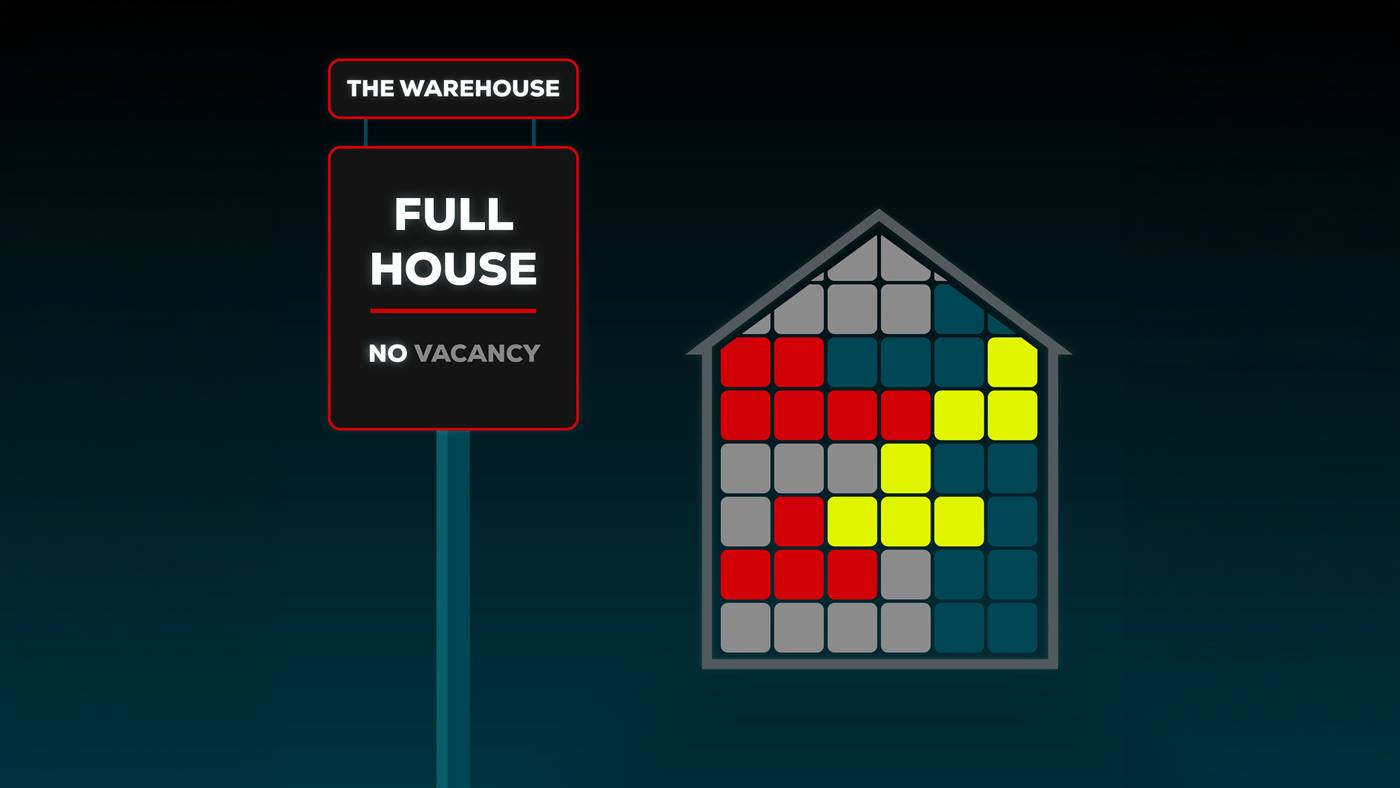
As SKU counts grow, storage density falls. Fewer pallets per SKU means a greater number of unique pick faces, each of which needs to remain accessible for picking rather than stored for pure density. New positions are squeezed in to accommodate products that did not exist five years ago, often in the same square footage.

On the order fulfillment side, teams of associates manually build multi-SKU pallets, pulling cases from multiple locations to assemble exactly what each customer needs. That finished pallet containing multiple SKUs, configured specifically for the store receiving it, is what the industry calls a rainbow pallet or store-ready pallet, depending on its composition. It allows lower order quantity, it is labor-intensive, and it is increasingly the norm.

The numbers illustrate the problem. Fulfilling 1,000 cases an hour at the full pallet level might require two forklift operators, based on 25 cases per pallet and 20 pallets per operator per hour. The same volume fulfilled at the case level can require five or more, assuming a case pick and pallet build rate of around 200 cases per operator per hour. SKU proliferation creates a storage problem and a labor problem simultaneously, and the two exacerbate each other.

Pallet composition determines the ASRS

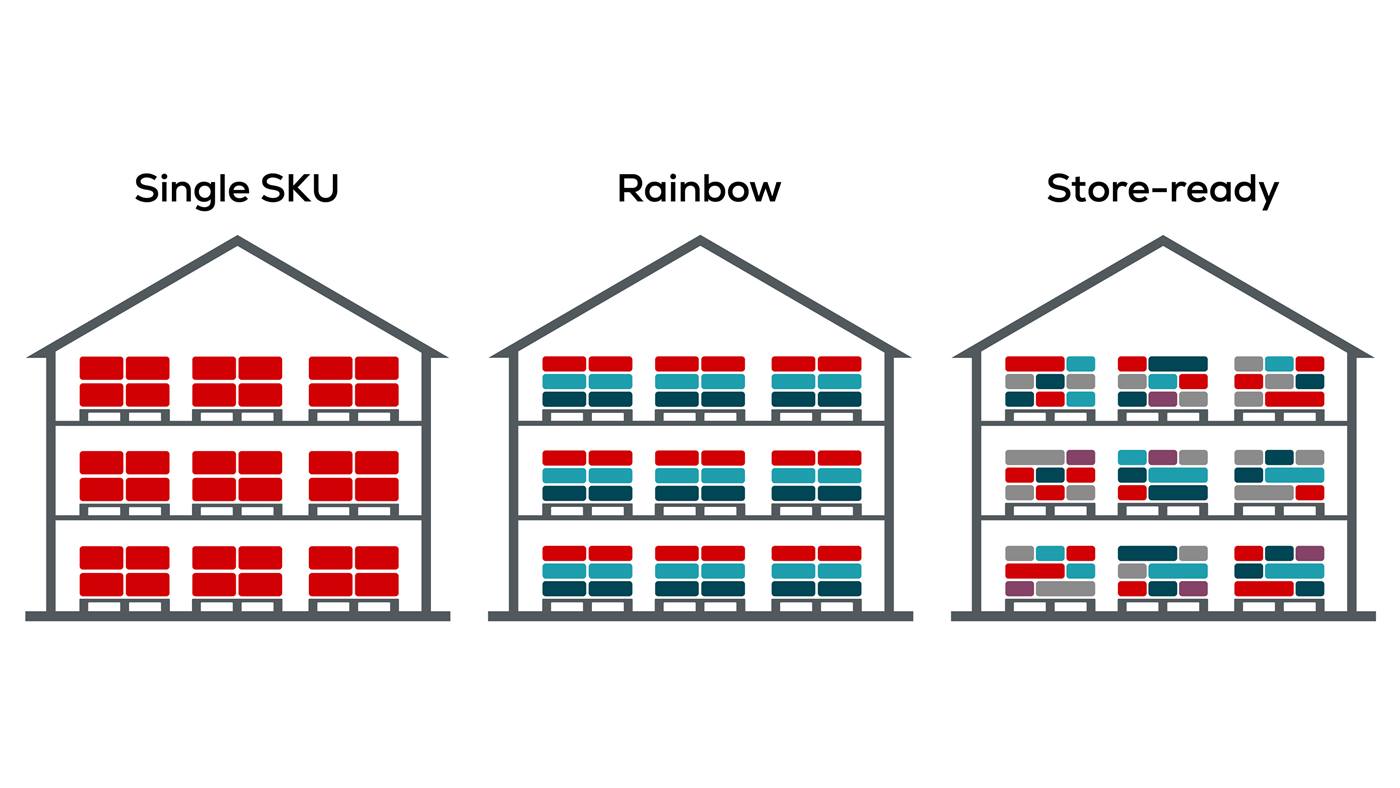
The type of storage and retrieval system required is determined by how the pallet is built. For single SKU pallets presented at high rates, traditional ASRS solutions are most ideal – that’s what they were designed to do.  As additional SKUs are introduced and layers become required, the demands on the system change, and more flexible automation becomes more suitable. For some products, manufacturers still move such high volumes that they’re shipping entire pallets of single SKUs. In this case, the choice of automation is typically straightforward, and post-pick handling is often minimal.

The introduction of “rainbow pallets”, typically defined as pallets comprised of unique SKUs by pallet layer, begins to complicate the chosen automation.  In this case, multiple donor pallets are required to satisfy needs, requiring more complex automation.  It stands to reason that this level of fulfillment requires more touches - as the pallet fulfilled is a wholly different pallet than the pallet produced by the manufacturer.  The pallet construction requires some form of intervention, whether manual or robotic.

Finally, "store-ready" pallets have the most complex requirements. Not only are there multiple SKUs in the pallet, but each of the layers on the pallet can be comprised of multiple SKUs. Essentially, the demand from downstream is at quantities “less-than-layer”. This method is often how grocers prefer to ship from their distribution centers to their stores, in order to conserve labor at the store level, but has become much more common among manufacturers offering Direct Store Delivery (DSD) fulfillment. DSD methods require “store-ready” pallets to limit the amount of time a truck stops at a customer and therefore maximize the number of customers that truck and driver can service in a day.

As depicted in the chart below, the answer is seldom clear-cut, and there is always nuance involved in the sizing and selection of the automation. Ultimately, however, the smaller the denomination at which customers can order, the more complicated and expensive the fulfillment becomes; both manually and automated.

Single SKU Pallet (High pallets/SKU) Single SKU Pallet (Low pallets/SKU) “Rainbow Pallets”: Layer Demand (pallets built with single-SKU layers) “Store Ready” Pallets: Case Demand (pallets built with mixed-SKU layers)
Vectura Fit Fit Can feed one of the options below
PowerStore Ideal Fit Poor Fit
AgileStore Poor Fit Ideal Fit
Static Layer Pick Gantry     Strong Fit Not a Fit
CarryStar     Strong Fit Not a Fit
ACR (Hai/Geek+)     Poor Fit Strong Fit
AutoStore AutoCase     Poor Fit Strong Fit
Manual Picking Area     Poor Fit Poor Fit

Why is traditional warehouse automation struggling with SKU proliferation?

Much of the automation installed in F&B distribution centers over the past decade was designed for high-volume, low-SKU operations fulfilled predominantly at the pallet level. It has performed well in that context. The challenge is that the context has changed and will continue to change.

Large-scale automation projects carry long lead times, which means a system designed for today's product range may already be misaligned by the time it goes live. Fixed crane systems are designed to deliver product to specific drop-off and pickup points in front of each aisle, requiring central pallet movement infrastructure such as monorails, conveyor loops, or AGVs to route product elsewhere in the building. Where that infrastructure does not exist, pallets must be moved manually. Where it does exist, it can quickly reach capacity when additional movement is required. When full-pallet fulfillment was the only requirement, this was not a problem: pallets were simply brought out to docks for shipment. As requirements shift toward less-than-pallet fulfillment, it becomes a major issue.

What automation solutions support high-SKU F&B fulfillment?

This article focuses primarily on pallet-level automation for storage and movement but provides a brief overview of all three levels of automation below: pallet, layer, and case.

Newer 4-way roaming pallet shuttle systems like AgileStore are designed around a different set of priorities than traditional deep-lane counterparts. Deployment timelines are shorter, reducing the risk of building for a business that has already moved on. They are viable in brownfield buildings with lower ceiling heights, which matters for manufacturers on legacy sites.

Crucially, product can be delivered from any storage position to any location on the system perimeter, meaning a case-picking area can be added or repositioned without redesigning the storage system behind it. Storing more is only half the answer. How that stock is accessed and moved is what determines whether the operation can keep up.

It is worth noting that 4-way shuttles are not the right fit for every application. They move more slowly than traditional mother-and-child shuttle systems, so where throughput is high and pallets per SKU are plentiful, a different solution may still be more appropriate.

Layer-level automation, including standalone robotic layer pickers, layer pick matrix gantries, and AMR-based dynamic layer pick fields, allows pallets to be broken down into individual layers of demand. These systems can also depalletize and singulate cases for automated storage at the case level.

For store-ready pallet building, the simplest starting point is often manual case picking from source pallets to destination pallets, with the pallet automation system used to replenish source locations. Where case-handling automation becomes justified, cases are typically stored in a case ASRS, whether shuttle-based, AutoStore with AutoCase, or an ACR-style solution.

At the highest end of the throughput and complexity spectrum, full robotic mixed-SKU store-ready palletizing becomes viable. This requires quick-retrieval case storage, strict conveyor sequencing, and robotic palletizing working in combination. Swisslog's ACPaQ solution addresses this requirement, typically fed from a pallet ASRS.

Automatisert robotarm fra Swisslogs ACPaQ-løsning som utfører blandet kassepalletering i et matproduksjonslager.
ACPaQ is Swisslog’s fully automated order picking solution for mixed case pallets.

Understanding downstream complexity

The requirements of the pallet's end user, whether a retail store, distribution centre, or delivery route, directly influence which storage system is most appropriate. The greater the complexity required downstream, the higher the throughput demand and the more sophisticated the system must be. Route-specific pallets, for example, require a high-throughput pallet ASRS, a separate case buffering and sequencing engine, and robotic case handling. This is a topic for a future article.


How should F&B manufacturers future-proof their warehouse automation? 

The forces driving SKU proliferation are structural. Channel fragmentation, private label economics, and consolidation activities do not reverse. F&B manufacturers planning their warehousing around today's product range will find themselves replanning sooner than expected.

The more useful question is what a distribution operation needs to look like to handle the range it will have in five years. Flexibility, shorter lead times, and the ability to adapt without starting from scratch are becoming baseline requirements rather than nice-to-haves.

Many F&B warehouses are already building multi-SKU pallets every day. Not all of them are built to do it efficiently.

FAQ

What is a rainbow pallet and what is a store-ready pallet?

This blog post refers to a rainbow pallet as a pallet with multiple SKUs, but each layer on the pallet is the same SKU. The name reflects the visual variety of different products on the same pallet, and when viewed from the side appear to have multi-colored “bands” of product. Alternatively, a “store-ready” pallet is a pallet with multiple SKUs, but each of the layers can contain multiple SKUs. Traditionally, both rainbow pallets and store ready pallets tend to be built manually from multiple storage locations and require significantly more labor than full-pallet picking.  

What is SKU proliferation in food and beverage?

SKU proliferation is the rapid growth in distinct product variants, including different pack sizes, regional labels, private label products, and channel-specific formats, that food and beverage manufacturers must manage. Driven by channel fragmentation, private label production, and industry consolidation, product ranges across the sector have increased by up to ten times over the past fifteen years.

Why do “rainbow” or “store ready” pallets require more labor than full-pallet picking?

Rainbow pallet building requires a picker to visit multiple storage locations and retrieve individual cases. Full-pallet picking requires a forklift to move a completed pallet from one location to another. Fulfilling the same volume at layer or case level can require five or more pickers compared to two at the pallet level, a labor ratio of more than two to one for the same throughput.

What is a 4-way roaming pallet shuttle system?

A 4-way roaming pallet shuttle is an automated storage and retrieval system in which autonomous shuttle vehicles travel in all four directions within a racking structure, retrieving and depositing pallets from any position. Unlike fixed stacker crane systems, which operate in a single aisle, shuttle vehicles can route product to any point on the system perimeter, providing the flexibility that multi-SKU and case-picking operations require.

How does a 4-way shuttle differ from a traditional stacker crane or mother-and-child system?

Unlike fixed stacker crane systems, 4-way shuttles operate in brownfield buildings with lower ceiling heights, deploy in shorter timelines, and can deliver product from any storage position to any perimeter location. This makes it better suited to operations where rainbow pallet building locations need flexibility, or where the SKU range is likely to change. Swisslog's 4-way roaming pallet shuttle solution is developed in partnership with Euro Fork.

Should F&B distribution centers replace existing automation for rainbow or “store ready” pallet operations?

Not necessarily. Many facilities benefit from a hybrid approach, using existing crane-based systems for the dense storage of high-volume stable lines and adding more flexible shuttle or AMR-based systems to handle layer-level or case-level access for rainbow or “Store Ready” pallet building. The right configuration depends on ceiling height, SKU profile, throughput requirements, and site constraints.

Her skriver:
Wofford Wise

AutoStore Sales Director

Mer om Wofford Wise
Søk gjennom alle Tags
Vertical Farming Smart Cities Customer Service and Maintenance Vlogs Sustainability Light Goods AutoStore Robotics Micro Fulfillment Future Logistics Design and Planning E-Grocery Software White Paper Video Case Study Pallet Automation
Neste artikkel
Design & Consulting Grant Beringer 2. november 2026
How to deliver a successful warehouse automation project

A warehouse automation project succeeds when the operating requirements, delivery process and people are aligned. Here is what that means from the first planning through go-live and beyond.

Det kan også interessere deg