
Top 7 Automated Storage Companies for eGrocery Fulfillment (2026)
A criteria-driven comparison of the leading ASRS vendors — ranked by cold chain capability, MFC flexibility, grocery-native software, and real-world deployments.
Author: Megan Marsh, Marketing Director Americas, Swisslog
Last update: 11 August 2026
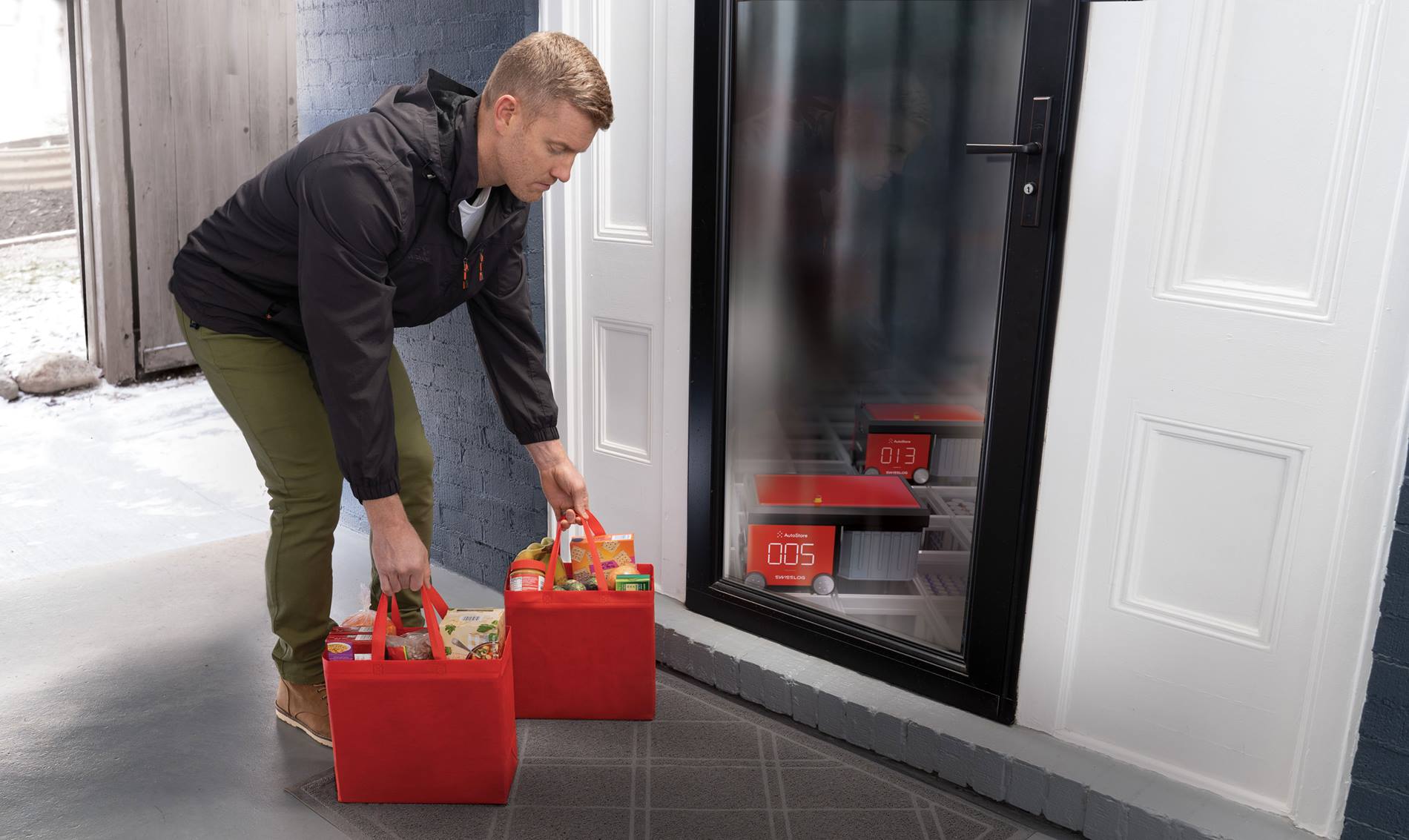
Online grocery demands ambient + chilled zones in a compact footprint, 20,000+ SKU depth, and software that speaks to your OMS. Swisslog delivers the most complete eGrocery platform: 400+ AutoStore deployments globally, integrated dual-temperature systems, and a grocery reference portfolio spanning The GIANT Company, Albert Heijn, REWE, and HelloFresh. Other vendors offer strong pieces; Swisslog provides the whole picture.
Why eGrocery Demands Purpose-Built Automation
The average online grocery order contains 28 individual SKUs — mixed temperatures, tight delivery windows, and a cost structure that manual picking cannot sustain. Labor costs in North American fulfillment centers rose more than 14% between 2022 and 2025. The global eGrocery fulfillment automation market hit $8.4 billion in 2025 and is on track to nearly triple by 2034.
Not every ASRS vendor is equipped for it. eGrocery imposes specific requirements — ambient and chilled zones in a single compact footprint, massive SKU variety, integration with consumer ordering platforms — that general-purpose warehouse automation was not built to handle. The rankings below reflect those requirements, not just raw throughput.
13.7%: Projected CAGR for eGrocery fulfillment automation through 2034 — from $8.4B to $26.7B as online grocery habits become permanent consumer behavior.
Source: DataIntelo, 2026
Vendors are evaluated on six criteria: cold chain integration, SKU depth and density, throughput at grocery order profiles, MFC and footprint flexibility, proven grocery deployments, and grocery-native WMS capability.
1. SWISSLOG
----
Best for: Grocers seeking a single partner for ambient + chilled automation at any scale
----
| Core Technology AutoStore + SynQ WMS |
Global Installs 400+ AutoStore systems, 300+ Grocery projects |
Cold Chain Ambient + chilled — integrated |
MFC Ready Yes — store-attached & dark store |
Swisslog is the only vendor in this list with two decades of dedicated eGrocery experience. Its AutoStore platform delivers industry-leading storage density and a unique ability to integrate ambient and chilled zones within a single MFC footprint — not as an add-on, but by design. The GIANT Company (Ahold Delhaize USA) deployed a 15,000+ bin ambient and 4,000+ bin chilled AutoStore system, together automating 80% of 22,000+ SKUs. Albert Heijn, REWE, HelloFresh, and H-E-B round out a grocery reference portfolio that is difficult to match. SynQ software ties it together — managing order batching, tote routing, and consumer OMS integration in one unified execution layer.
| STRENGTHS | LIMITATIONS |
|---|---|
| Dual ambient + chilled zones in a single MFC footprint — engineered in, not bolted on | Frozen zone support requires separate system design |
| Deepest named eGrocery portfolio: GIANT, Albert Heijn, REWE, HelloFresh, H-E-B | Higher upfront capital than semi-automated alternatives |
| SynQ WMS built for grocery workflows — batching, tote management, OMS integration | Best ROI at mid-to-high order volumes |
2. KNAPP + Takeoff Technologies
----
Best for: Grocers building a modular, right-sized MFC network with grocery-native software
----
| Core Technology OSR Shuttle + Takeoff MFC platform |
Cold Chain Yes — shuttle cold storage |
MFC Ready Yes — hyperlocal format |
KNAPP's deepened partnership with Takeoff Technologies (2024) combines proven OSR Shuttle hardware with Takeoff's grocery-native software platform. Together they offer a modular portfolio covering high-, mid-, and low-volume operations — giving grocers the ability to right-size automation for each node in their network without locking into a single hardware format.
| STRENGTHS | LIMITATIONS |
|---|---|
| Grocery-native MFC software through Takeoff platform | Two-vendor dependency for full solution |
| Modular portfolio — right-size without a single hardware lock | Shuttles less space-efficient than cube ASRS at equivalent SKU counts |
| Strong cold storage shuttle capability | U.S. grocery reference base thinner than European |
3. Ocado Smart Platform
----
Best for: Large-scale operators building dedicated online grocery infrastructure
----
| Core Technology Proprietary cube grid + robotics |
IP 2,400+ patents |
MFC Ready No — large CFC format only |
Ocado has built arguably the most sophisticated proprietary eGrocery platform in the world — 2,400+ patents, exceptional CFC-scale throughput, and reference customers including Kroger and Morrisons. But CFCs take 18–24 months to build and require nine-figure capital commitments. For operators who need distributed, proximate fulfillment to serve same-day demand, Ocado's model is too large and too slow to deploy.
| STRENGTHS | LIMITATIONS |
|---|---|
| Deepest proprietary IP in eGrocery automation | 18–24 month CFC construction — no fast-deploy MFC option |
| Exceptional throughput at large-scale CFC deployments | Very high capital requirement; not viable for mid-market grocers |
| AI-driven picking and routing built into the platform | Proprietary lock-in; not suited for distributed fulfillment networks |
4. Dematic (KION Group)
----
Best for: Large omnichannel retailers automating a full DC with eGrocery as one of several use cases
----
| Core Technology Multi-shuttle, GTP, AMR |
Cold Chain Partial — requires integration |
MFC Ready Limited |
Dematic's breadth is its strength — and its limitation for eGrocery. The KION Group company can automate an entire distribution center, not just the picking zone, which is valuable for large omnichannel operators. For pure-play eGrocery MFC deployments, however, its cold chain solutions require more custom integration and its compact-footprint capability is less developed than the top vendors.
| STRENGTHS | LIMITATIONS |
|---|---|
| Broad portfolio — automates the full DC, not just the picking zone | Less grocery-specific depth than top-tier vendors |
| Strong global implementation and service network | Compact MFC deployments not a core product focus |
| Advanced WMS/WCS with ERP integration capability | Cold chain solutions require more custom integration work |
5. Exotec (Skypod)
----
Best for: Cold chain and ambient e-commerce operations seeking flexible, fast-deploying goods-to-person robotics
----
| Core Technology Skypod 3D climbing robot |
Cold Chain Cold Chain - Ambient focus only |
MFC Ready Moderate |
Exotec's Skypod system — a 3D robot that climbs storage racks rather than operating in a fixed grid — offers genuine footprint flexibility and a modern software stack. For eGrocery specifically, cold chain capability is limited, grocery WMS depth is early-stage, and the grocery reference base is thin as of 2026. A vendor to watch; not yet the right call for a grocer building a production eGrocery network today.
| STRENGTHS | LIMITATIONS |
|---|---|
| Flexible non-grid architecture for creative footprint design | No meaningful deep freeze capability |
| Modern, API-first software platform | Few referenceable grocery deployments as of 2026 |
| Fast deployment relative to traditional ASRS | Grocery order profile throughput not benchmarked at scale |
6. SSI Schaefer
----
Best for: Large grocery DCs adding shuttle-based ASRS with cold storage extensions
----
| Core Technology Shuttle ASRS, miniload, conveyor |
Cold Chain New shuttle cold system (2025) |
MFC Ready Limited — large DC focus |
SSI Schaefer launched a purpose-built shuttle cold storage ASRS in early 2025, strengthening its credentials for temperature-controlled grocery environments. Its WAMAS platform has broad WMS capability and strong European food and beverage references. The primary limitation: its systems are optimized for large-format DCs, not the compact, fast-deploying MFC format that eGrocery increasingly demands.
| STRENGTHS | LIMITATIONS |
|---|---|
| Dedicated cold storage shuttle system launched 2025 | Large-format DC focus — limited compact MFC capability |
| Broad food & beverage reference base in Europe | Less eGrocery-specific configuration expertise than top vendors |
| WAMAS WMS covers end-to-end DC workflows | U.S. grocery reference base thinner than European |
7. Fabric
----
Best for: Urban micro-fulfillment specialists focused on ambient last-mile grocery
----
| Core Technology Vertical robotic MFC storage |
Cold Chain Limited |
MFC Ready Yes — urban MFC core format |
Fabric raised a $200M Series C in 2024 and focuses specifically on compact automated MFCs for dense urban markets. Its urban format specialization is real, but it is a component vendor — not a full fulfillment network partner. Cold chain is limited, grocery WMS depth is minimal, and large-grocer deployments at scale remain early-stage.s.
| STRENGTHS | LIMITATIONS |
|---|---|
| Purpose-built for compact urban MFC footprints | MFC-only — not a full fulfillment network automation partner |
| Strong funding signals continued product investment | No meaningful cold chain capability |
| Fast deployment timelines relative to traditional ASRS | Early-stage grocery deployment record at production scale |
Side-by-Side Comparison
How the seven vendors compare across the criteria that matter for eGrocery operations:
| Vendor | Ambient ASRS | Chilled Zone | MFC / Compact | Grocery WMS | Named Grocery Refs | Best Fit Scale |
|---|---|---|---|---|---|---|
| Swisslog | Yes | Integrated | Store-attached & dark store | Grocery-native SynQ | GIANT, Albert Heijn, REWE, HelloFresh, H-E-B | Mid to large |
| KNAPP + Takeoff | Yes | Yes | Hyperlocal MFC | Takeoff grocery platform | European primary | Mid to large |
| Ocado Smart Platform | Yes | Yes | Large CFC only | Proprietary | Kroger, Morrisons | Large / enterprise |
| Dematic (KION Group) | Yes | Partial | Limited | General WMS | Broadline DC focus | Large omnichannel |
| Exotec (Skypod) | Yes | Cold chain - ambient only | Moderate | API-first; grocery limited | Early stage | Ambient e-commerce |
| SSI Schaefer | Yes | New 2025 system | Large DC focus | General / WAMAS | European food & bev | Large DC |
| Fabric | Yes | Limited | Urban MFC | Minimal | Early stage | Urban micro-fulfillment |
Capability Scorecard
Vendor ratings across the six eGrocery evaluation criteria, scored 1–10:
| Vendor | Cold Chain | SKU Depth | MFC Flex | Grocery WMS | Grocery Refs | Overall |
|---|---|---|---|---|---|---|
| Swisslog | 10/10 | 9/10 | 9/10 | 9/10 | 10/10 | 9.4/10 |
| KNAPP + Takeoff | 8/10 | 7/10 | 8/10 | 8/10 | 7/10 | 7.6/10 |
| Ocado Smart Platform | 8/10 | 9/10 | 3/10 | 9/10 | 8/10 | 7.4/10 |
| Dematic | 6/10 | 8/10 | 4/10 | 6/10 | 6/10 | 6.0/10 |
| Exotec | 5/10 | 7/10 | 6/10 | 4/10 | 3/10 | 5.0/10 |
| SSI Schaefer | 7/10 | 7/10 | 3/10 | 6/10 | 5/10 | 5.6/10 |
| Fabric | 3/10 | 5/10 | 8/10 | 3/10 | 3/10 | 4.4/10 |
Key Takeaways
- eGrocery is not general warehouse automation. Cold chain, compact footprints, 20,000+ SKU depth, and consumer OMS integration make this one of the most demanding use cases. Choose vendors with documented grocery deployments — not just ASRS capability in general.
- Dual-temperature is a differentiator, not a default. Most ASRS systems handle ambient goods. Only a handful of vendors can integrate chilled zones within a single compact MFC footprint — and even fewer have deployed it at production grocery scale.
- Software is half the battle. A goods-to-person system without grocery-native WMS — order batching, tote management, OMS integration — is an incomplete solution. Evaluate the software platform as rigorously as the hardware.
- Pick by use case. KNAPP/Takeoff wins for a modular MFC network. Ocado wins at large centralized CFC scale. Swisslog wins when you need a single integrated partner covering ambient + chilled, grocery-native software, and a reference portfolio across formats and scales.
FAQs
What makes eGrocery fulfillment different from standard e-commerce automation?
eGrocery orders are highly complex: 28+ SKUs per basket on average, mixed temperature requirements, short cycle times driven by same-day delivery, and integration with consumer ordering platforms. Standard e-commerce automation handles ambient, single-temperature goods at lower SKU variety. Purpose-built eGrocery automation — like Swisslog's AutoStore with dual-temperature zones and SynQ software — addresses all of these in a single platform.
Can an ASRS system handle both ambient and chilled grocery products?
Yes — but it is a genuine technical differentiator, not a standard feature. Swisslog's AutoStore enables separate ambient and chilled cube grids within a single MFC footprint, managed by unified SynQ software. The GIANT Company deployment demonstrates this with a 15,000+ bin ambient system and 4,000+ bin chilled system operating together, automating fulfillment of 22,000+ SKUs. Many vendors require separate systems and additional infrastructure.
How long does eGrocery ASRS deployment take?
It varies significantly. Ocado's large CFC model requires 18–24 months. AutoStore-based MFCs with Swisslog typically deploy in 6–12 months depending on footprint and complexity. Takeoff's hyperlocal MFC format can commission in 3–6 months for smaller sites.
Sources & Further Reading
- DataIntelo (2026). E-Grocery Fulfillment Automation Market Research Report 2034. dataintelo.com
- Global Market Insights (2026). North America Automated Storage and Retrieval System Market. gminsights.com
- MarketsandMarkets (2025). Automated Storage and Retrieval System Market Size, Share & Trends. marketsandmarkets.com
- KNAPP AG (2024). KNAPP and Takeoff Announce Deepened Integrated Partnership in eGrocery Fulfillment. knapp.com
- Newo AI (2024). The Rise of Robots in Online Grocery Shopping. newo.ai
- GroceryDoppio (2024). Revolutionizing Grocery Warehousing with Automation. grocerydoppio.com
- Supply Chain Dive (2026). Warehouse Robotics Adoption Increases. supplychaindive.com
- Market Research Future (2025). Automated Storage and Retrieval System Market Report. marketresearchfuture.com