What is AutoStore? A Complete Guide to AutoStore ASRS
AutoStore is a cube-based automated storage and retrieval system (ASRS) that stacks inventory in bins and uses robots to deliver them to workstations on demand, with thousands of installations worldwide. This guide explains how the system works, covering the grid, bins, robots, ports and software, and shows where AutoStore outperforms other storage options and where it falls short. It also breaks down costs, ROI and implementation timelines to help you decide whether AutoStore is the right fit for your warehouse.
TL;DR
AutoStore is a compact, automated storage and retrieval system designed for small to medium-sized products. The system includes four basic components with near-infinite opportunities for configuration and expansion. With a simple design and flexibility, AutoStore systems work well with other automated warehouse solutions across a variety of industries. AutoStore provides high-density storage and very fast throughput capabilities compared to other automated storage and retrieval systems, helping companies meet consumer demand, avoid facility expansion, and limit headcount without affecting productivity.
What is AutoStore?
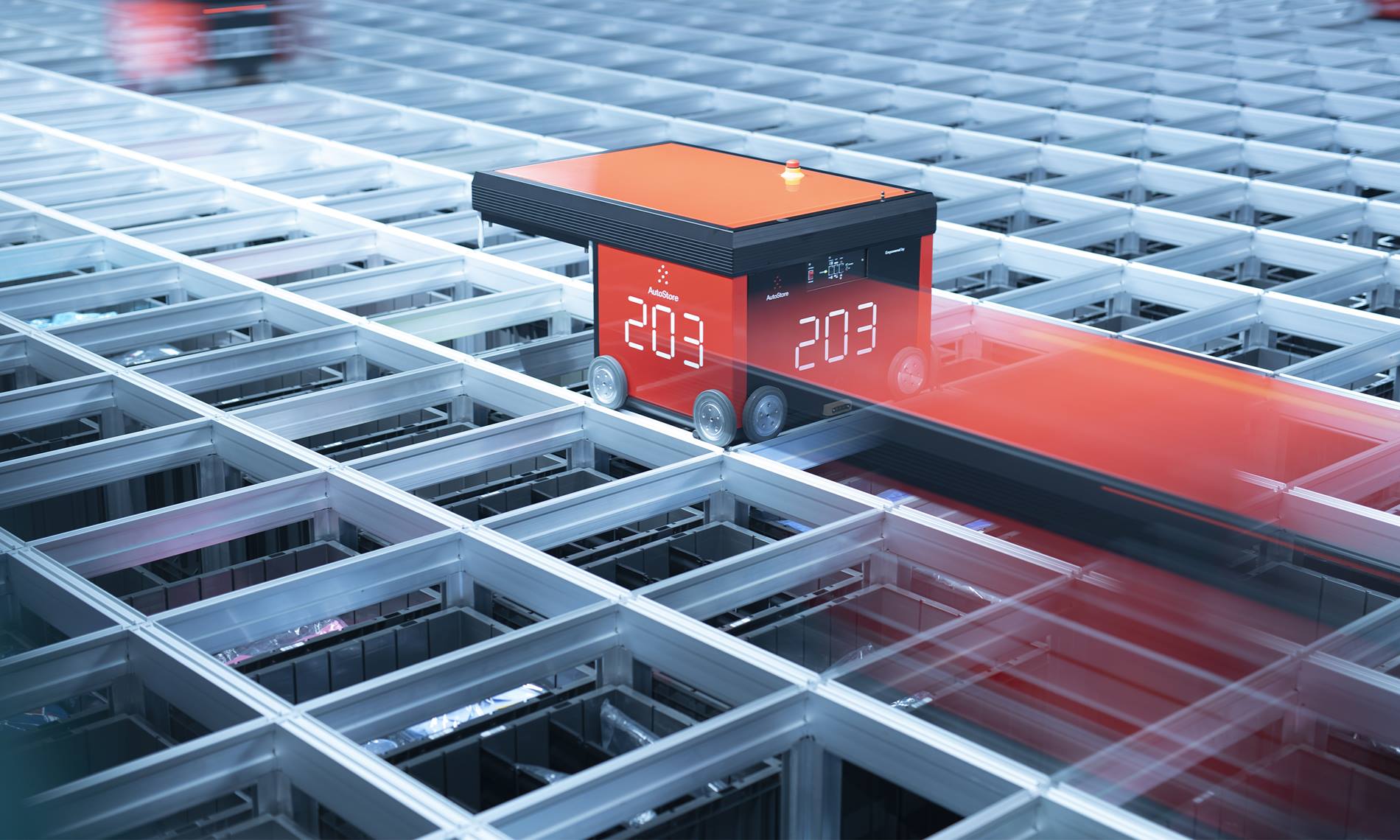
An AutoStore is an automated storage and retrieval system (ASRS) that deposits and collects products stored in bins stacked vertically within a cube-based grid. Automated robots move across the top of the grid, grab storage bins, and carry them to ports for restocking or picking. Vertically stacking bins enables high-density storage, placing products much closer together than in traditional warehouses with aisles and shelving.
Does AutoStore (the company) sell AutoStore (the system)?
AutoStore is a proprietary system manufactured by its namesake company, AutoStore. AutoStore (the company) manufactures the systems and develops the software that controls the robots' movement. But it doesn’t install or maintain AutoStore systems or provide the warehouse execution software (WES) to orchestrate AutoStore movement with other automated solutions.
What is an AutoStore integrator?
Instead of selling systems directly to customers, AutoStore partners with integrators. These logistics companies manage every step of getting the AutoStore ASRS into the customer's warehouse—from creating quotes to offering post-install service plans. Integrators collaborate closely with customers to:
- Design the system that works best for their warehouse.
- Develop customized software to integrate AutoStore ASRS systems with other warehouse automation solutions and warehouse management systems (WMS).
- Install AutoStore system hardware.
- Integrate and test software.
- Maintain and service AutoStore systems (customer-dependent).
How does AutoStore work?
Products move from input ports, where they are placed in bins, to storage within the grid. When an order is received, robots bring the bin containing the product to an output port for picking. In more detail:
- Workers place products in AutoStore bins at the input ports, also known as put-away stations.
- The bins move into the AutoStore grid, where products can be stored indefinitely.
- Depending on demand, products will move within different layers of the AutoStore ASRS system. High-demand products remain near the top of the grid for easy access, while low-demand products move deeper into the grid.
- The WES batches orders to optimize retrieval.
- Robots pull bins containing products and carry them to ports.
- A worker or piece-picking robot removes products from the bin and either packs the order at the port or sends it to a packing station.
What are the different parts of an AutoStore ASRS?
Each AutoStore installation is unique. Grid shape and size and number of bins, robots, and ports vary by warehouse throughput, SKU variety, and facility requirements. However, all AutoStore systems have four basic components:
- AutoStore grid: Durable, lightweight aluminum structures hold the bins in place and provide a scaffold for the robots.
- AutoStore bins: Shelving within the grid holds bins. Bins must be the same height within an individual AutoStore system but can be divided to contain different SKUs.
- AutoStore robots: Automated units equipped with lifting straps and a gripper plate retrieve bins from the grid and then bring them to the grid columns connected to the ports for picking or restocking.
- AutoStore ports: Inbound products are placed in bins at ports, and outbound products are picked to either be packaged at the picking station or sent to another area of the warehouse for packing.
Absolutely. AutoStore ASRS pairs well with other automated warehouse technology—when equipped with the right WES. You can use conveyors, piece-picking robots, carousels, autonomous mobile robots (AMR), and more alongside an AutoStore ASRS to complete your intralogistics system.
Here’s a hypothetical example of multiple automated components working together within a single facility:
- High-bay ASRS stores larger items and pallet loads
- AutoStore ASRS processes small and medium-sized items
- Conveyors link automated solutions
- AMRs move goods to picking stations
- Piece-picking robots supplement human operators
A high-performing, intelligent WES is critical to combining automation solutions. The WES orchestrates the disparate systems to optimize operations.
Can AutoStore be expanded later?
Yes; AutoStore ASRS are designed to grow with your business. You can expand AutoStore systems over time by increasing the number of robots, bins, or ports. Which component you increase depends on your needs.
| Warehouse needs | Warehouse expansion opportunity |
|---|---|
| Store more inventory | Add AutoStore bins and increase AutoStore grid size |
| Increase throughput to meet customer demand | Add AutoStore robots to existing grid |
| Reduce picking bottlenecks | Add AutoStore ports to support additional pickers |
What is the difference between an AutoStore and a shuttle system?
Both AutoStore ASRS and shuttle systems rely on automation to move products within a warehouse or distribution center. However, AutoStore keeps products within its grid, while shuttle systems move products between different parts of the warehouse. AutoStore ASRS has higher storage density than a shuttle system, meaning it holds more product while taking up less floor space. In addition to optimizing floor space, AutoStore ASRS can be easier to implement and expand than a shuttle system because of its modular design.
Are AutoStore grids customizable?
Yes. AutoStore grids are modular and can be tailored to each warehouse. For example, AutoStore grids can span multiple floors or encompass existing architectural features (such as pillars) in brownfield sites. You can also expand the structure as SKU counts or product volume increase.
How many boxes can an AutoStore grid store?
How many boxes do you need? AutoStore grids can incorporate anywhere from 5,000 to 300,000 storage boxes. The grid structure’s maximum height is 6 meters, and it requires 1.8 meters of ceiling clearance for the robots to operate. However, AutoStore grids can scale almost indefinitely in length and width.
How does a fire suppression system work with AutoStore grids?
Fire suppression systems, such as sprinklers, must be mounted outside of the AutoStore grid. If the product intended for storage and retrieval in your AutoStore requires fire suppression systems to be installed very close to where it is stored, consider other automated solutions.
What types of robots does AutoStore use?
AutoStore’s current robot lineup is the Red Line: the R5, R5+, R5 Pro and R5+ Pro. All Red Line robots have a bin-lift mechanism mounted on the robot’s main body. AutoStore introduced the Black Line (B1 robot) in 2019 for very high-throughput systems, and it was deployed on some projects. With the introduction of the R5 Pro robots, however, the Black Line offering was discontinued because both lines offered similar product features. Sites that already run B1 robots can still expand their systems with R5+ robots.
Within the Red Line, the main difference is between the standard models (R5 and R5+) and the Pro models (R5 Pro and R5+ Pro). Pro robots are built for large, multi-shift operations: they achieve higher throughput per robot, so the same workload needs fewer robots and fewer charging stations. The taller “+” models (R5+ and R5+ Pro) are the only AutoStore robots that can carry all three bin sizes, including the 425 mm bin.
How many AutoStore robots do I need?
The number of AutoStore robots you need depends on your throughput requirements. There is not a set number of robots deployed with each AutoStore system. Because the system is modular, you can easily add or remove robots to accommodate demand fluctuations.
How much energy do AutoStore robots use?
Lower energy use reduces operational costs—an important consideration when evaluating new warehouse technology. AutoStore robots use only 0.1 kW of energy per hour. This means six AutoStore robots use the same amount of energy as a household toaster.
Can I use my own bins in an AutoStore?
When transitioning from traditional aisle-and-shelving storage to AutoStore, it can be tempting to use existing hardware. However, you must use AutoStore bins in an AutoStore system. The AutoStore bins feature custom gripper plates and are manufactured to meet the tight tolerances required to operate within the high-density AutoStore grid.
What products can AutoStore handle?
AutoStore ASRS handles products that fit within the storage bin capacity and 30 kg weight limit. This includes small and medium-sized items.
Product size restrictions don’t limit the industries AutoStore supports. For example, in a distribution center for an e-commerce fashion company, an AutoStore system can process most types of clothing and accessories. In an automotive parts warehouse dealing with a variety of SKU types, the AutoStore system could handle small components, such as spark plugs, while other ASRS solutions store larger or unwieldy parts, such as windshields.
What sizes are the AutoStore bins? Do the AutoStore bins have a weight or volume limit?
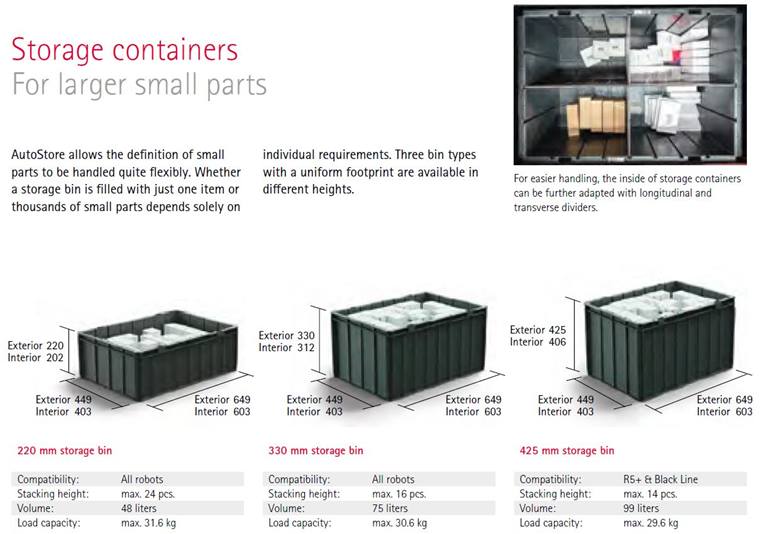
AutoStore bins come in three heights to accommodate different SKU types. They can also be divided to carry multiple SKUs within a bin. Each AutoStore bin size has a maximum load capacity of 30 kg. The heights include:
- 220 mm storage bin: carries up to 49.08 liters
- 330 mm storage bin: carries up to 75.81 liters
- 425 mm storage bin: carries up to 98.17 liters
The tallest AutoStore bin requires the AutoStore R5+ Pro robot to operate. The shorter AutoStore bin sizes are compatible with all robot types.
Does stacking bins slow AutoStore down?
Reaching products stored farther down in the AutoStore system takes longer than reaching those stored at the very top. However, over time the system will naturally place more commonly picked SKUs on top, while less commonly picked items end up near the bottom. Intelligent software can further improve this process.
AutoStore: Diseño modular con las innovaciones de Swisslog
No importa el aspecto de tu nave. Con la solución de almacenamiento compacto AutoStore podemos diseñar la forma más óptima del automatismo, contemplando formas particulares, columnas, diferentes alturas de nave u otras peculiaridades del espacio. Incluso se pueden implementar túneles y puentes si la solución lo requiriese.
A continuación podrás descubrir los componentes de AutoStore y otros extras que Swisslog puede ofrecerte...

-
-
-
-
Cubetas y almacenamiento
![]()
La retícula es de aluminio y supone la estructura básica de la solución AutoStore, determinando la capacidad de almacenamiento del sistema. Mantiene las cubetas en su lugar y también sirve para que los robots se puedan mover sobre ella. En la parte superior de la cuadrícula, los raíles se disponen tanto en la dirección x como en y, para que los robots puedan acceder a todas las posiciones de almacenamiento dentro de la misma.
El hecho de que un contenedor de almacenamiento se cargue con un solo artículo o con miles de piezas muy pequeñas depende únicamente de los requisitos individuales de cada empresa. Para un manejo más fácil, el interior de las cubetas de almacenamiento se puede personalizar aún más con divisores longitudinales y transversales. Además hay, con una cubeta sin compartimentos, tres tipos de cubetas de diferentes alturas. -
-
-
-
Módulos de Reticula asísmica para la estabilidad
![]() La actividad sísmica en varias partes del mundo podría causar problemas a AutoStore, comprometiendo los carriles rectos o posiblemente la estabilidad de la red. Pero gracias a las estructuras de reticula asísmica diseñadas por Swisslog, el sistema tiene una mayor resistencia en caso de actividad sísmica.
Las torres asísmicas de Swisslog se integran perfectamente en la red Autostore y han sido probadas en varias instalaciones en zonas de alta sismicidad. Las estructuras de la reticula sísmica ofrecen una mayor protección frente a la actividad sísmica local sin afectar al rendimiento de AutoStore ni obstaculizar los futuros planes de ampliación del sistema.
Dependiendo de las propiedades mecánicas del suelo, el paso entre las torres y el tipo de anclaje pueden ajustarse para tener en cuenta las actividades sísmicas locales.
-
Estación de limpieza de sensores
![]()
La estación de limpieza del sensor AutoStore se instala en una celda de la retícula. La gestión de limpieza de sensores fue desarrollada especialmente por Swisslog y se fija en la cuadrícula de una celda. Los robots se mueven sobre la celda y los sensores, que necesitan para medir la trayectoria, se limpian de polvo. Esto permite que funcionen mejor durante más tiempo.
Además, se necesitan menos limpiezas manuales y, en general, esto minimiza los costes de mantenimiento de la empresa que decide instalar un Autostore con Swisslog. -
-


How fast is AutoStore? How many picks per hour can AutoStore systems handle?
AutoStore robots zip along at up to 3.1 meters/second—similar to a brisk jog. With strategic WES helping map storage and pickup locations, an AutoStore ASRS can process 20,000 or more picks per hour, making it the fastest ASRS per square foot available worldwide.
After the operator logs in, the first bin arrives within minutes. Then bins are presented to operators continuously. In high-throughput systems, AutoStore can present 30 to 40 bins per hour, with a few seconds of exchange time.
Picking speed depends on order profile. For large orders picked from multiple bins, operators can generally perform at least 250 picks per hour. For smaller orders picked from a single bin, picking speed increases to 350 picks per hour. Installing ports optimized for picking and batching orders can further increase picking speed up to 650 picks per hour.
What are the different types of AutoStore ports?
AutoStore currently offers ten port and workstation types, and integrators combine them to fit each warehouse’s workflow. Options include:
- CarouselPort: Bins rotate on a built-in carousel beneath the picking opening, so the next bin is ready while the operator picks from the current one. CarouselPort also supports inserting and removing bins from the grid.
- ConveyorPort: Bins enter the workstation on a conveyor, one after the other, and conveyor speed adapts to each operator. Its simple design gives access to all bins in the grid.
- FusionPort: AutoStore’s ergonomic, high-speed port handles up to 550 bins per hour through two independent bin openings. Openings tilted at 15 degrees, safety hatches and built-in pick-to-light reduce the reaching and twisting that cause fatigue on long shifts.
- FusionPort Staging: Combines picking and staging at the same station, so operators can return finished orders to the grid and free up floor space.
- VersaPort: A low-cost, modular workstation with a safety hatch. Ports run alone or link in groups of up to three for inbound, picking, consolidation, kitting or pick-and-stage workflows, at up to 180 bins per hour (240 on a mezzanine).
- SwingPort: Rotating arms bring bins from the storage bin lift to a workstation outside the storage area that stays connected to the grid. SwingPorts work well with multi-level AutoStore ASRS configurations.
- RelayPort: Robots present multiple bins simultaneously for better order sequencing and fast item exchange between robot and operator.
- PickUpPort: Consumers collect orders directly from publicly accessible ports, enabling in-store pickup.
- CarouselAI: Adds an AI-driven robotic arm to the CarouselPort for automated piece picking. AutoStore rates it at up to 650 units per hour and around 90% of typical e-commerce SKUs.
- VersaAI: A lights-out robotic workstation that works inside the grid, pre-picking and buffering orders and consolidating partially filled bins during off-peak hours.
Are all AutoStore ports the same?
As with the other AutoStore system components, AutoStore ports can be customized to meet each warehouse's needs. The ports can bring items to ergonomic workstations staffed by workers or piece-picking robots. Ports typically bring products to workers via a built-in carousel, but can use conveyors instead or include different sequencing and staging options.
What are the benefits of using AutoStore ASRS?
Warehouses need ways to keep up with the ongoing challenges, such as increasing SKU volumes, multi-channel fulfillment, and rising demand for accurate, near-instant delivery. AutoStore ASRS helps warehouses solve existing problems and prepare for an unpredictable future.
Benefit #1: AutoStore optimizes space with high-density storage
Making the most of your warehouse space reduces the need to expand existing facilities or build new ones. By stacking bins vertically, AutoStore systems can provide 4x the storage of a traditional warehouse with aisles and racking. Compared with many other ASRS systems, AutoStore provides the highest-density storage for large-volume, small or medium-sized SKUs.
Case study—Logistics company increases storage volume in same footprint with AutoStore
Yusen Logistics Singapore implemented an AutoStore ASRS to operate within a high-mix, high-volume environment. Within the same footprint, Yusen Logistics Singapore increased storage capacity from 2,000 cubic meters to 3,500 cubic meters. With AutoStore, the company improved throughput by 200% and could offer customers same-day delivery—a huge differentiator in their industry.
Case study—Grocer expands existing AutoStore facilities
UK grocer Asda serves over 18 million customers and has over 550 stores and more than 75,000 products. In other words, it’s big. To handle small items and react to customer demand, Asda set up an AutoStore in 2013. In 2015, they further expanded their AutoStore operations with a second grid. AutoStore helps Asda keep its shelves stocked by doubling pick rates and increasing pick accuracy to 99.8%.
AutoStore storage density: How much warehouse space can you really save?
Optimizing space savings can prevent companies from costly expansions or new builds. Space savings vary drastically by warehouse; the following table provides a rough estimate.
| Storage and retrieval system | Space-saving method | Pros | Cons | Estimated space savings |
|---|---|---|---|---|
| AutoStore ASRS | Stacks products vertically in a tight grid; keeps multiple SKUs in a single bin; robots provide automated retrieval; no aisles | Efficient, high-throughput | Limited by SKU size | 60–75% |
| Traditional racking | Store products vertically, with aisles between shelving for access | Simple and quick to deploy | Requires manual labor to store and retrieve items, limiting accuracy and speed | Not applicable |
| Vertical lift modules | Stacks products vertically; uses trays to deliver items to picking stations; no aisles | Work with products of varying sizes and weights | Less efficient than cube-based storage because of limited access points | 60–85% |
| Mini-load ASRS | Small cranes move between shelves containing products; no aisles | Modular and scalable; cost-effective | Limited by SKU size; less efficient than AutoStore | Up to 75% |
| Shuttles | Autonomous shuttles transport products, requiring less aisle space and more compact racking | Integrate with other automation solutions; work in unconventional facilities | Less efficient than cube-based storage | 35%–60% |
Note that saving space is one aspect of choosing the right type(s) of automated storage for your warehouse. Automation should solve multiple problems (e.g., increase storage and throughput) and work with the SKU volume and type your warehouse processes. In many warehouses, multiple types of automation optimize space over a single type.
Benefit #2: AutoStore increases throughput to meet customer and consumer demand
Consumer demand for same-day delivery and expedited shipping is expected to continue to grow over the coming years. Companies working to meet this demand increasingly need faster logistics support in their warehouses, back-end stockrooms, and distribution centers.
By automating storage and retrieval, AutoStore systems drastically increase warehouse throughput. Implementing AutoStore in your warehouse can allow you to set (and meet) customer service level agreements for faster delivery, helping your business stand out from competitors.
Case study—AutoStore provides highly efficient in-store order fulfillment for technology retailer
TRUE Branding Shop set up an AutoStore system in its retail space at ICONSIAM mall in Bangkok, Thailand. The AutoStore ASRS accomplished two goals: increasing order fulfillment speed by bringing products directly to consumers from storage, and highlighting sophisticated technology. The speed and spectacle of the AutoStore system drew casual shoppers and tech fanatics alike. In other words, AutoStore was on brand for TRUE.
Case study—Complex order fulfillment system improves throughput without sacrificing quality
HelloFresh, a meal delivery service, needed a way to expand its menu without slowing fulfillment—all within a refrigerated environment. They combined manual picking with an AutoStore ASRS system containing almost 30,000 bins, 150 robots, 18 picking ports, and 11 induction conveyor ports. WES software orchestrated movement and provided visibility to ensure products remained fresh. With the AutoStore system in place, HelloFresh could handle growing demand while maintaining order accuracy and freshness.
Benefit #3: AutoStore builds flexibility into your warehouse operations
Today’s logistics companies face supply chain issues, ongoing worker shortages, and geopolitical instability. Increasing operational flexibility with AutoStore ASRS builds resilience, helping companies thrive amid changes. Changes can include:
- Workforce fluctuations: Finding sufficient numbers of employees to staff growing warehouses can be tough, especially with fierce competition. Logistics companies face high staff turnover, which increases administrative expenses. Training new staff takes time and can reduce productivity. In addition to hiring and keeping employees, warehouses often have unpredictable staffing needs due to seasonal fluctuations in demand. By automating manual tasks, AutoStore ASRS enables a lean staffing strategy, which saves money and can withstand fluctuations.
- Omnichannel fulfillment: Fast, efficient picking via AutoStore can help companies simultaneously fulfill customer and direct-to-consumer orders. Or, in retail, hold stock for the store while fulfilling online orders.
- Supply chain disruptions: Major weather events or geopolitical instability can delay transportation of important goods and jeopardize customer-level agreements. Storing additional, high-demand items in AutoStore ASRS can help prevent disruptions from significantly impacting the business.
Case study—E-commerce retailer drastically reduces staffing requirements via AutoStore
Sportamore, a Norwegian online sports retailer, needed a way to meet rapid growth while supporting its wide range of products, brands, and suppliers. The company implemented an AutoStore solution alongside automated-assisted pick-and-pack processes. With AutoStore in place, Sportamore simultaneously reduced staffing needs by 75% and doubled its storage capacity.
AutoStore benefits summary
AutoStore ASRS provides:
- High throughput and flexibility: Improve operation speed and adaptability
- Space optimization: Cube-based storage offers the highest-density ASRS option
- Proven results: AutoStore is an established presence—over 20 years in business and thousands of installations worldwide
- Accuracy: Technology ensures the right items come to ports each time; 99.9% pick accuracy
- Labor savings: No need to increase headcount during peaks; less reliant on a stable workforce
- Energy efficiency: Robots use limited amounts of energy
- High uptime: AutoStore systems can work 24/7; when robots break down others can take their place
What is the ROI for an AutoStore system?
The first question stakeholders ask is when they will start seeing the benefits from purchasing and setting up AutoStore cube-based storage in their warehouse. Typically, companies achieve return on investment (ROI) within two to three years of implementing an AutoStore system. ROI comes from:
- Labor savings
- Higher throughput
- Increased storage density
Is AutoStore ASRS worth it?
Compiling the costs for purchasing, building, and maintaining an AutoStore ASRS can feel overwhelming, but the value the system delivers offsets the costs. If AutoStore is the right fit for your warehouse, it can deliver:
- Labor savings: direct full-time employee reduction and reduced reliance on temporary labor, shift count costs (e.g., supervision, utilities), and recruiting and onboarding costs.
- Expansion within existing facilities: avoid the extensive expense of a new build or expanding existing buildings, consolidate operations if possible, increase active pick facings for simultaneous picking, free up real estate if consolidating operations.
- Reduced capital equipment costs: including powered equipment (e.g., forklifts), racking, and pick modules.
- Operational and strategic benefits: improve shipping rates, avoid carrier upcharges, expand SKU range, create a safer working environment by reducing manual labor requirements, increase performance consistency.
Since AutoStore ASRS can last over 20 years, factor the total cost of ownership for a holistic, accurate view of system costs. Consider upfront capital expenditure and implementation costs, plus inflation-adjusted ongoing costs such as maintenance, system upgrades, and staffing.
What are the upfront costs of owning an AutoStore?
AutoStore system hardware and software can cost tens of millions of dollars. The exact figure depends on grid size, number of robots, number of picking ports, and add-on components. Each AutoStore is unique, and the price varies accordingly.
In addition to capital expenditure on the system, AutoStore upfront costs include:
- Site preparation, such as leveling floors before system installation
- Electrical and infrastructure upgrades to accommodate the system
- Systems integration and IT project costs
- Productivity losses during the transition period
- Staff training
What ongoing costs does an AutoStore ASRS have?
Once your AutoStore is in place, expenses include software fees, maintenance and service costs, and spare parts holding expenses. Consider:
- WMS, warehouse control system (WCS), and WES licensing
- Integration middleware for enterprise resource planning (ERP), order management system (OMS), and transportation management system (TMS) software
- Preventative maintenance such as inspections, calibrating equipment, and replacing worn parts
- Emergency maintenance services to fix parts during peak productivity hours
- Carrying on-site spare parts inventory for critical components
- Dedicated maintenance teams
- Service contracts with AutoStore integrators
What kind of maintenance does an AutoStore system need?
Maintenance is an important consideration for warehousing, where facilities often operate long hours with few breaks. AutoStore ASRS robots will require periodic maintenance and servicing. The AutoStore grid has a spot for robots with problems to pull off and move to a service area. When a robot is down, another can take its place to sustain throughput.
How do I train staff to maintain an AutoStore?
AutoStore integrators can help train staff to operate, troubleshoot, and maintain the system. Many AutoStore integrators also offer service packages that include full-time, onsite staff or dedicated teams available to address any issues that arise.
The benefit of onsite AutoStore maintenance and service teams from integrators is a direct line to the system designers and immediate support. As integrator employees, they also don't rack up the same costs as traditional employees (e.g., benefits, insurance, administrative costs, supervisory hours, etc.).
AutoStore systems offer major benefits by increasing throughput, easing workforce woes, improving flexibility, and meeting growing demands. In most cases, there is a strong argument for using AutoStore in your warehouse. In some cases, other types of automation may better meet the need.
What factors should I consider before choosing AutoStore for my warehouse?
Use the following factors to help determine if AutoStore is right:
- SKU volume: Do you have a lot of different types of SKUs coming through your warehouse? Or do you typically deal with limited SKUs? AutoStore can handle any SKU volume, but the system is especially well-suited for high-volume warehouses because it can store multiple items in a single bin.
- SKU type: Are you dealing with large or small products? Or a mix? If dealing with large variances in size and shape, consider vertical lift modules or high-bay ASRS over AutoStore since the system is limited by bin height.
- SKU distribution: AutoStore holds the most benefit for warehouses that need to store many products but only see a small percentage of those products leave. For example, 20% of SKU volume may drive 80% of the orders. Since the most important products naturally move closer to the top of the shelves, this situation is ideal for AutoStore. If your SKUs are equally popular, another ASRS solution will better optimize your operations.
Can AutoStore be used in e-commerce?
Absolutely, AutoStore can be used in e-commerce and retail. AutoStore ASRS drastically increases throughput to meet consumer demand for rapid delivery and accurate orders. By automating manual tasks, AutoStore systems can increase pick performance by 50% or more, saving hours in order fulfillment. AutoStore ASRS can also be combined with automated solutions, such as piece-picking robots and packing automation, to further speed up fulfillment.
Is AutoStore ASRS right for fashion and retail companies?
Yes, AutoStore ASRS can provide the scalability and speed fashion and retail require. Consumer demand changes quickly, and warehouses, distribution centers, and back rooms need the flexibility to adjust. The AutoStore system offers:
- Incremental investments: scale as your business grows
- Flexible fulfillment: custom options tailored to your SKU type and volume
- Omnichannel fulfillment (e-commerce and store replenishment options)
- High-density storage to speed fulfillment
Case study—AutoStore streamlines and simplifies order fulfillment for an industrial equipment retailer
United States retailer Northern Tool’s manual, three-level pick module didn’t provide enough support to meet customer demand. The company integrated an AutoStore ASRS with their custom packaging technology to pick orders directly into right-sized boxes. The custom solution freed almost 50,000 square feet of warehouse space while optimizing direct-to-customer and store fulfillment.
How does AutoStore ASRS benefit the food and beverage industry?
To meet regulatory requirements, food and beverage companies often need to store products for specific time periods at specific temperatures. AutoStore ASRS can operate in frozen and refrigerated environments and provide visibility and real-time inventory insights, so food and beverage companies know exactly what products are available.
Can AutoStore be used in grocery distribution?
Automating storage and retrieval with AutoStore ASRS meets many challenges for grocery distribution companies, including:
- Expanding e-commerce capability and store replenishment—all within the same system
- Providing the option to create micro-fulfillment centers to accelerate deployment time
- Reducing product waste by ensuring timely handling
- Managing chilled, frozen, and ambient temperature goods in one system
- Improving inventory visibility and accuracy
Case study—Tri-temperature storage with AutoStore ASRS
French grocer La Réserve des Saveurs implemented a first-of-its-kind AutoStore ASRS to store and retrieve frozen, refrigerated, and dry products within the same building. Typically, these item categories are stored in separate facilities. The new system centralized all orders, reducing the grocers’ carbon footprint and improving efficiency.
How can AutoStore benefit the aerospace and automotive industries?
Assembling cars, trucks, and planes requires many small and medium-sized components. AutoStore systems can’t store and retrieve windshields or landing gear, but they can easily and quickly gather the other items needed to create them.
AutoStore ASRS can also support aftermarket aerospace applications. For example, Satair Singapore used an AutoStore to manage approximately 80% of its small and medium-sized spare aircraft parts. The aerospace logistics company can get parts to customers in Southeast Asia quickly and accurately.
What technology does AutoStore need?
Modern warehouses depend on technology to keep everything running smoothly. AutoStore ASRS requires two types of technology: proprietary software created by AutoStore to operate the robots within the grid and a WES layer to coordinate the system’s movements with the rest of the warehouse.
Can I use my WES to control AutoStore?
Although companies can use their own WES to control automated systems within their warehouses, AutoStore integrators typically offer a version that is tailored to make the most of the AutoStore system. With a customized, intelligent WES, AutoStore improvements can include:
- Optimized robot movement: Software can increase fulfillment speed by managing where AutoStore bins are stored and which robots (hint: the closest ones) gather the items.
- Dynamic inventory management: Match stock levels with consumption and forecasted needs and improve operations with real-time inventory insight.
- Ease of use: Intuitive user interfaces improving onboarding for maintenance and operations staff.
How does AutoStore work with a WMS?
AutoStore proprietary hardware and the WES used to orchestrate operations are both governed by the existing WMS system, which tracks everything from purchase orders to delivery receipts. An AutoStore system does not replace the WMS. Look for an AutoStore integrator with the capacity to easily incorporate AutoStore tech within the tech you already use on a daily basis in your warehouse.
How do I choose an AutoStore integrator?
Who you choose to work with can determine the project's success. Look for an experienced AutoStore integrator with a high customer return rate and a reputation for excellent customer experience. Consider the integrator’s service plan options and any technical differentiators. Prioritize integrators with a collaborative mindset, a deep portfolio, and proven dedication to developing AutoStore products within their company.
What are the AutoStore implementation steps?
Generally, AutoStore implementations follow similar steps. Once customers approve the integrator’s quote, the integrator finalizes the design and confirms the order to AutoStore (the company) to deliver the hardware (mainly robots, charging stations, controls) according to project plan. While AutoStore assembles the robots, the integrator orders bins, grid structure, other construction elements and customizes the software, and the customer prepares their warehouse and WMS.
The full responsibility for the AutoStore commissioning is with the integrator. The experts come on-site to install the hardware and software. Integrators and customers ramp up the AutoStore system and the integrator hands over the system to the customer when previously agreed acceptance criteria are met. The system is ready to go live.
What is the AutoStore software development process?
AutoStore integrators customize software for each implementation. The process includes:
- Meeting with customer operations and software teams to develop functional specifications
- Software development and testing
- Installation
- Onsite and user acceptance testing
How long does it take to install AutoStore?
For an average-sized system with average complexity, AutoStore ASRS installation takes 10 to 14 months. Although 6 months is often quoted as the standard AutoStore ASRS installation time, installations rarely happen that quickly without drastically increasing expenses and simplifying the system. Factors that impact AutoStore installation timelines include:
- System size
- Number of add-on components
- Customer response time
- Testing requirements
- Site access
- WMS readiness
- Permitting